It might sound a little strange to be talking about hydrangeas in February, but if you garden in mild climates like the Pacific Northwest and southern areas of the U.S., it’s possible for you to start working on your hydrangeas now.
SHOULD YOU PRUNE YOUR HYDRANGEAS NOW
Depending on the kind of hydrangea you have, pruning might be one thing to tackle. However, if you garden in an area that has seen fluctuating late winter and early spring temps, I would hold off a bit longer.
Hydrangea pruning you might be able to do now (depending on the species) when all danger of frost has passed:
- For big-leaf hydrangeas (macrophylla), mountain (serrata), climbing, and oakleaf (quercifolia) hydrangeas, no pruning since they bloom on old wood. Their buds have already formed and pruning them now will guarantee you get no flowers. Wait until you see broccoli or after they flower. I recommend you hold off on the 4Ds as well (dead, diseased, damaged, dysfunctional wood) to avoid an early stimulation response.
- Smooth hydrangeas (arborescens) and panicle hydrangeas (paniculata) can be pruned now since they bloom on new wood. Again, though, keep your eye on the weather. You don’t want to make your cuts and then have a freeze that will shock the plant. Instead, prepare to make your cuts just before your plant breaks dormancy, i.e., when you see some green color along the stems. And please, no cutting down to ground level unless your plant has been severely damaged somehow.
If you’re unsure what type you have, it’s safer to wait until later in the season when you can at least see some foliage and determine which stems have live buds.
See a full discussion of pruning woodland and panicle hydrangeas here.
GENERAL HYDRANGEA MAINTENANCE
- Remove any dead, diseased, downward-facing and damaged branches (4Ds) on all types, cutting back to healthy wood when all danger of frost has passed.
- Check for winter damage and remove broken stems.
- Do not deadhead if you have a rebloomer until all danger of frost has passed.
- Apply a 2-3 inch layer of mulch around the base if you haven’t already, keeping it a few inches away from the stems. This helps retain moisture for spring.
- Check your irrigation set up if you have one. Soaker hoses can become clogged and automatic systems should have been blown out last fall. If not, get to it!
PLANNING AHEAD
- If the ground is workable, you can prepare planting sites where you are planning to add or transplant hydrangeas this spring.
- If you live in a mild climate (zones 8-9), late February is when you might start seeing early leaf buds on some varieties.
- If you garden where late season frosts occur after your plants break dormancy, you might be wise to lay in a supply of protective cloths/barriers, etc. in case you need to run out and do some last-minute wrapping.
FEBRUARY IS ABOUT CLEAN UP AND PREP
The main thing is to hold off on major pruning unless you’re certain you have a type that blooms on new wood. February is really more about cleanup and prep work than active intervention. So clean and sharpen your tools, map out your strategy (like which plants will be moved, which ones you will compost, and what new plants you want to add). You can lay in your supply of biological treatments for insects and disease, and order your compost and fertilizer. They can be delivered to the door which is much easier than dragging those big bags around.

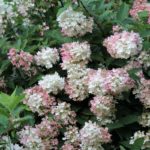
Hydrangea Arborescens Incrediball Holding Up To Snow
ATTEND A LOCAL FLOWER SHOW
Find a local flower/garden show to attend. They are everywhere. Your favorite search engine can give you all the details, I’m sure. You’ll be inspired and invigorated to start a new gardening season.
OTHER NEWS
I have been working on a new book about hydrangea pruning. If you want to get on the list to be notified of its release, just go to the Contact Lorraine Ballato tab on my site and let me know.
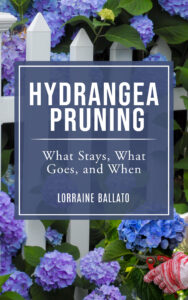
The cover of my next book about hydrangea pruning – subject to change, of course.
Thanks for reading!
6 Secrets for Stunning Hydrangea Flowers
Get my FREE mini-guide with 6 fool-proof tips showing how to grow hydrangeas that produce the most amazing flowers.
No spam - I promise!