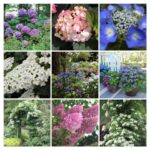
HYDRANGEA INSECT MANAGEMENT
Now that spring has sprung in many parts of the U.S., it’s time to talk about hydrangea insect management.
For me, insect management is all about doing no harm. There is no reason these days to use products that poison you, the gardener, or the planet.
If you have purchased my book, there is an entire chapter devoted to this topic. It might help you to review that for a more in-depth discussion. Note that the electronic version of my book would come in handy when you are out shopping for insect and disease control products. You can easily have it at the ready.
IPM Is The Way To Go
I encourage you to manage your garden and hydrangeas in accordance with basic principles of Integrated Pest Management (IPM). For our purposes, IPM is defined as an approach of managing pests that considers prevention, avoidance, monitoring, and suppression. When all else fails and you need to intervene by using a pesticide, use one of a biological nature that maximizes safety and reduces risk to the gardener and the environment.
IPM IS YOUR MANTRA
To start with, be aware that only 2 to 3 percent of all insects can actually harm plants. The other 97 percent just fly and crawl around as nature intended. They are part of an ecological system that needs them to exist to keep everything in balance.
With that in mind, I offer my rules of the road as you consider how to treat for insects.
- First rule of IPM is DO NO HARM, i.e., protect beneficials—the good guys in the garden—including ladybeetles, worms, frogs, spiders, and so forth.
- Always know the enemy (life cycle of the insect, how it develops and progresses) before doing anything so you know when to apply treatment for the most effective response.
- Remember that you need to have some bad bugs for the good bugs to eat. If the bad bugs aren’t around, the good bugs fly away. Complete annihilation is not the objective in integrated pest management.
- The first rule translates into a basic philosophy to start with the treatment that has the lowest impact. That could be something as simple as hand-picking the invaders.
- You need to be an observant scout and look for changes in your plants. Inspect the undersides of foliage with a magnifying glass or a hand lens ‘cause that’s where they hide out.
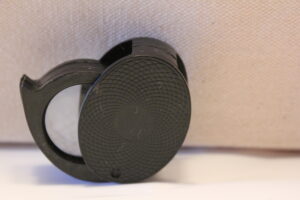
Hand Lens
Pay close attention especially as you approach your plant. Note if there are any unusual flying and crawling insects that make a run for it when they sense your presence. This will allow you to catch budding problems and address them ASAP.
GET HELP when you don’t know what’s going on. Your local extension office or a reputable independent garden center are good sources.
HOW TO TREAT HYDRANGEA INSECT ISSUES
If you decide to treat, this is the prescribed order:
- Use a strong stream of water to wash off insects without damaging your plants, where feasible.
- Try hand-picking: Although time-consuming this inexpensive technique addresses small insect populations, such as Japanese beetles. Check the undersides of leaves with a hand lens or magnifying glass, and squish bugs you find or possibly remove the leaf entirely. Taking a few minutes to do this regularly is a very effective control strategy to prevent serious problems.
- Use sticky traps:
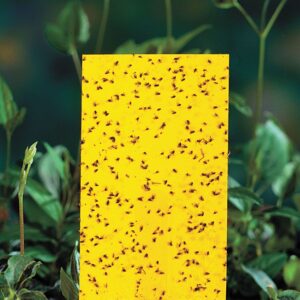
A Sticky Trap helps with identification
Traps attract insects using color and/or odor, holding them on a highly sticky surface. These work well when the insects first appear. They are especially helpful for insects that produce multiple generations in a season and for pest control if you don’t know what’s ailing your plant. (At the very least, you can catch a few to identify them.)
SPRAYS THAT CAN HELP
- Use insecticidal soap or horticultural oil:
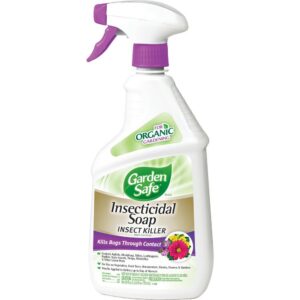
Insecticidal soap is a great non-toxic insect treatment
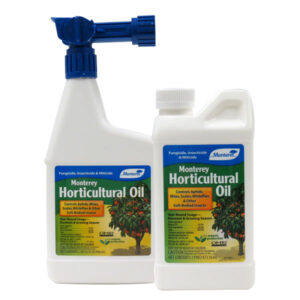
Horticultural oil is a great non-toxic insect treatment
Spraying these compounds suffocates insects such as whiteflies and aphids. Beneficials aren’t affected but you will need to reapply after rain. Sprays need to be applied primarily on leaf undersides where these insects hide—handy because the sun can cause burn spots on sprayed leaves.
- You can use Neem oil at 70 percent.
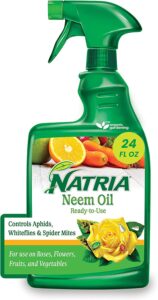
Neem oil for insect and disease control
It kills insects at all stages of development: egg, larvae, and adult with no effect on beneficials. The active ingredient, azadirachtin, works as an antifeedant, hormone disruptor, and by smothering. It forces the insect to stop eating and prevents the bug from transforming into its next stage of development by disrupting regulatory hormones. Its one drawback is that it’s effective only in cool, overcast, damp conditions.
USE OTHER PLANTS FOR CONTROL
- Grow plants near your hydrangeas that will draw beneficials into your garden. These companion plants are known as insectaries. They attract good bugs, which will then consume the bad bugs. That will cut down dramatically on your need for any intervention, which will save time, money, and energy and reduce your anxiety about this whole subject. Growers everywhere are incorporating these plants in their greenhouses and fields, and are saving tons of time and money with this insect management strategy.
Lay your supplies in now (if you don’t already have them) so you can be ready when the time is right.
FOR GARDENERS WHO NEED TO CONTROL DEER

Deer Defeat animal repellent
Let me share my own deer repellent story with you. A few years ago I did a trial with 3 containers of tulips (deer candy). I set them out in an area I knew our local deer traversed and then treated each of them with a different animal repellent. The container they avoided and which lasted longest was the one I sprayed with Deer Defeat. Since then, Deer Defeat has been my deer repellent of choice.
Luckily for you, management at Deer Defeat noticed my affinity for their product and are offering a discount to my readers who order direct from them. They have agreed to give you free shipping in the continental U.S. between now and Easter (April 5, 2026). When you get on the Deer Defeat website, the code to use is HYDRANGEAREADERS (it’s not case sensitive). The code provides free shipping for Deer Defeat repellent until Easter. So you have about 4 weeks to get this order in. I know that all deer herds are different and that from one year to the next, they change their habits.
I’m hopeful this product will work as well for you as it does for me. Note that I derive no income from your purchase.
THERE’S A NEW PLAYER IN HYDRANGEA-LAND
The hydrangea landscape is always changing, from new plants releases to removal of older options. I was delighted to see another organization is now in place to offer us more and better plants. It is called Garden District and they have formed a relationship with Dr. Michael Dirr. For those of you who don’t know who he is, let me share some info.
Dr. Michael A. Dirr, a renowned American horticulturist and professor emeritus at the University of Georgia is celebrated worldwide for his expertise in woody plants. With academic roots in Plant Physiology—holding a B.S. and M.S. from Ohio State University and a Ph.D. from the University of Massachusetts Amherst (1972)—he has left an indelible mark on horticulture through teaching, writing, research, and plant breeding.
Dr. Dirr has introduced over 200 new plants to the nursery trade. He has authored 10 books, including the iconic Manual of Woody Landscape Plants and Dirr’s Encyclopedia of Trees & Shrubs, along with more than 300 publications. He is also the inventor or co-inventor on 86 plant patents. To say he has had a profound impact on modern horticulture would be an understatement.
Dr. Dirr’s innovative breeding led to the development of the Endless Summer® series of hydrangeas, which transformed the hydrangea world forever. When you access the Garden District site, you will see no less than 4 new hydrangeas in addition to other plants. Keep your eyes peeled for some of these beauties to show up in a garden center near you.
HYDRANGEA PRUNING BOOK COMING SOON
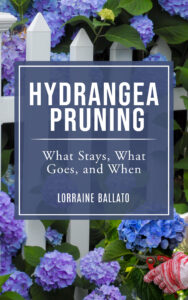
The cover of my next book about hydrangea pruning – subject to change, of course.
I am making steady progress on my new hydrangea pruning book and hope to have it available in a few short weeks. If you want to get on the list to be notified of its release, just go to the Contact Lorraine Ballato tab on my site and let me know.
PUBLIC SPEAKING DATES
I have two more public speaking dates in March. On March 18, you can catch me the Greenwich Botanical Center in Connecticut where I’ll be speaking about roses.
On March 21, I’m the keynote speaker at the Rensselaer County Spring Garden Day. The topic is “Hydrangeas: Bloom Without the Gloom.”
Tell/Bring your friends!
Thanks for reading.
6 Secrets for Stunning Hydrangea Flowers
Get my FREE mini-guide with 6 fool-proof tips showing how to grow hydrangeas that produce the most amazing flowers.
No spam - I promise!